What Happens to a Body After Death: Hour by Hour, Day by Day
What happens to a body after death, explained hour by hour and day by day, plus why an unattended death calls for certified, compassionate cleanup.
What happens to a body after death is a steady, predictable sequence of biological changes that begins within minutes and unfolds over hours, days, and weeks. Once the heart stops, circulation ends, the body begins to cool, and a series of well understood stages follows in a set order. Understanding that timeline can bring a measure of clarity to anyone who has lost someone, and it also explains something practical. As these natural processes advance, they can turn a private space into a real health hazard, which is why a death that goes undiscovered often calls for professional care rather than ordinary cleaning. This guide walks through what happens hour by hour and day by day, what speeds the process up or slows it down, and the point at which the aftermath becomes a biohazard.
The First Hours After Death
In the first hours, the changes are mostly internal and physical, and forensic professionals recognize them as distinct, orderly stages.
Cooling and Color Change
Within minutes, circulation stops and the skin loses its usual color, because blood is no longer being pumped through it. This change is known as pallor mortis. At the same time, the body begins to cool from its living temperature toward the temperature of the room around it. That cooling, called algor mortis, is gradual and steady, which is one reason it has long been used to help estimate how much time has passed.
Stiffening and Settling
Two further changes take hold over the same window. The muscles begin to stiffen in a process called rigor mortis, which generally starts within a few hours and works outward from the smaller muscles. Meanwhile, with circulation halted, gravity draws the blood to settle in the lowest parts of the body, leaving those areas darker. This settling is known as livor mortis. Together, these early signs give professionals a fairly reliable picture of the first hours.
The First Day
Across the first full day, rigor mortis reaches its peak and then gradually eases as the muscle tissue changes, so the stiffness that set in earlier relaxes again over roughly a day to two. Out of sight, a quieter process has already started. The body's own enzymes begin to break down cells from within, a natural step that sets the stage for everything that follows. Little of this is visible from the outside at first, but it marks the shift from the early physical signs to the longer process of decomposition.
The First Week
As the days pass, naturally occurring bacteria become the main drivers of change, in a stage known as putrefaction. This is when the process becomes noticeable rather than hidden. Gases build up within the body, the skin changes color, and a strong, distinctive odor develops and spreads through the surrounding space. The body may also begin to release fluids. The exact pace varies widely, but in an average indoor setting these signs typically appear within the first several days. It is during this window that an undiscovered death stops being only a personal loss and begins to affect the property itself, because those fluids and odors move into the materials of the home.
Weeks and Beyond
Given more time, decomposition continues through later stages that forensic science describes as active decay, advanced decay, and finally skeletonization, when only the most durable tissues remain. How long each takes is enormously variable. In some conditions these stages unfold over a few weeks, while in others they take months or far longer. Outdoors, insects and animals speed the process, while a cool, dry, enclosed space can slow it dramatically. The point worth holding onto is less about exact timing and more about direction. Without intervention, the process does not stop, and the longer a space is left, the deeper the contamination reaches.
What Changes the Timeline
No two situations follow the same clock, because several conditions push the process faster or slower. The table below outlines the main ones.
Factor | Effect on the Timeline |
Temperature | Heat speeds decomposition, cold slows it, and freezing can nearly halt it |
Humidity and moisture | Damp conditions tend to accelerate the process, while dry air slows it |
Indoor vs. outdoor setting | Outdoors exposes the body to weather, insects, and animals that speed change; indoors is more contained |
Air flow and enclosure | A sealed, still room slows some changes but concentrates odor and contamination |
Body and clothing factors | Body size, health, and covering all influence the rate |
Surrounding surfaces | Porous materials such as carpet, bedding, and flooring absorb fluids and hold odor |
Why an Unattended Death Becomes a Biohazard
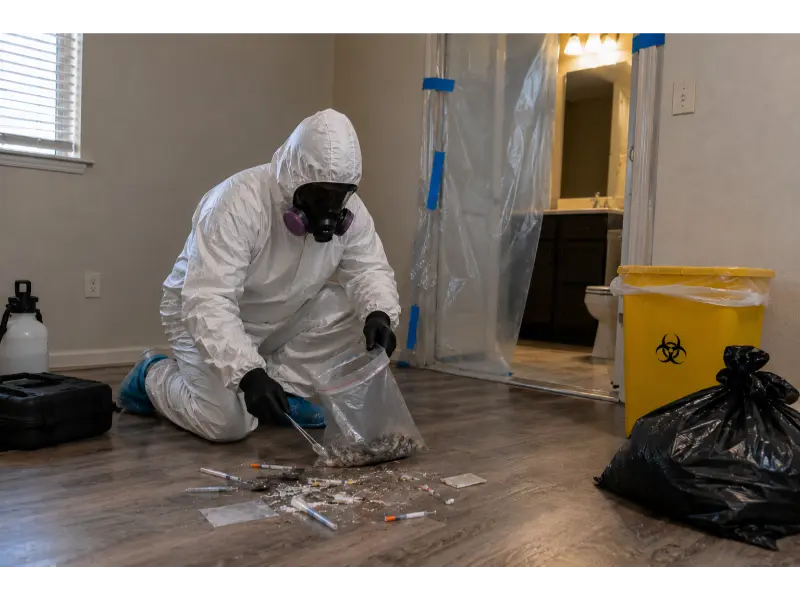
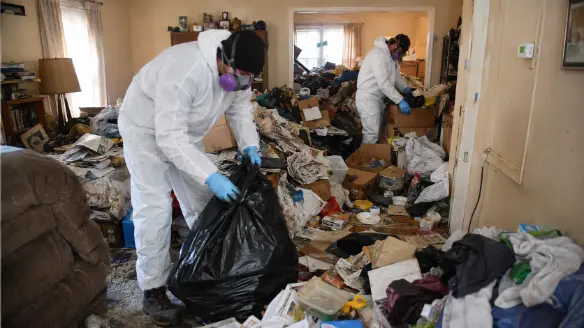
When someone dies and is not found right away, the natural processes described above create real hazards in the home. Bodily fluids carry bloodborne pathogens and bacteria that pose a health risk to anyone who enters, and they do not stay on the surface. Porous materials like carpet, padding, subflooring, mattresses, and even wall surfaces absorb what is released, so contamination reaches well beyond what the eye can see. Odor behaves the same way, settling deep into materials and ventilation rather than airing out on its own. This is the difference between hidden and visible contamination, and it is why ordinary cleaning cannot make the space safe. Proper unattended death cleanup means containment, removal of contaminated materials, decontamination, odor source treatment, and safe disposal, carried out under the standards that govern biohazard cleanup.
It also helps to know who does what. A coroner or medical examiner investigates and removes the person, and law enforcement handles any investigation. None of them clean the scene. That responsibility falls to the property owner or family once the scene is released, a point our guide on who is responsible for cleanup costs explains in more detail. A professional cleanup company steps in only after that release, to decontaminate and restore the space. We do not remove the body or determine the cause of death. Our work begins where theirs ends.
Compassionate Death and Suicide Cleanup
Few moments are harder than losing someone and then facing the aftermath in a place that is supposed to feel safe. When that happens, you do not have to manage it alone or attempt it yourself. Remnant is OSHA certified and available 24/7, and our technicians treat every scene with discretion and care, decontaminating and restoring the affected area while documenting the work to support an insurance claim, with a sliding scale for those without coverage. If you are dealing with an unattended death or any biohazard situation, reach our team for discreet, around the clock support. We are here when you need it most.
Learn